
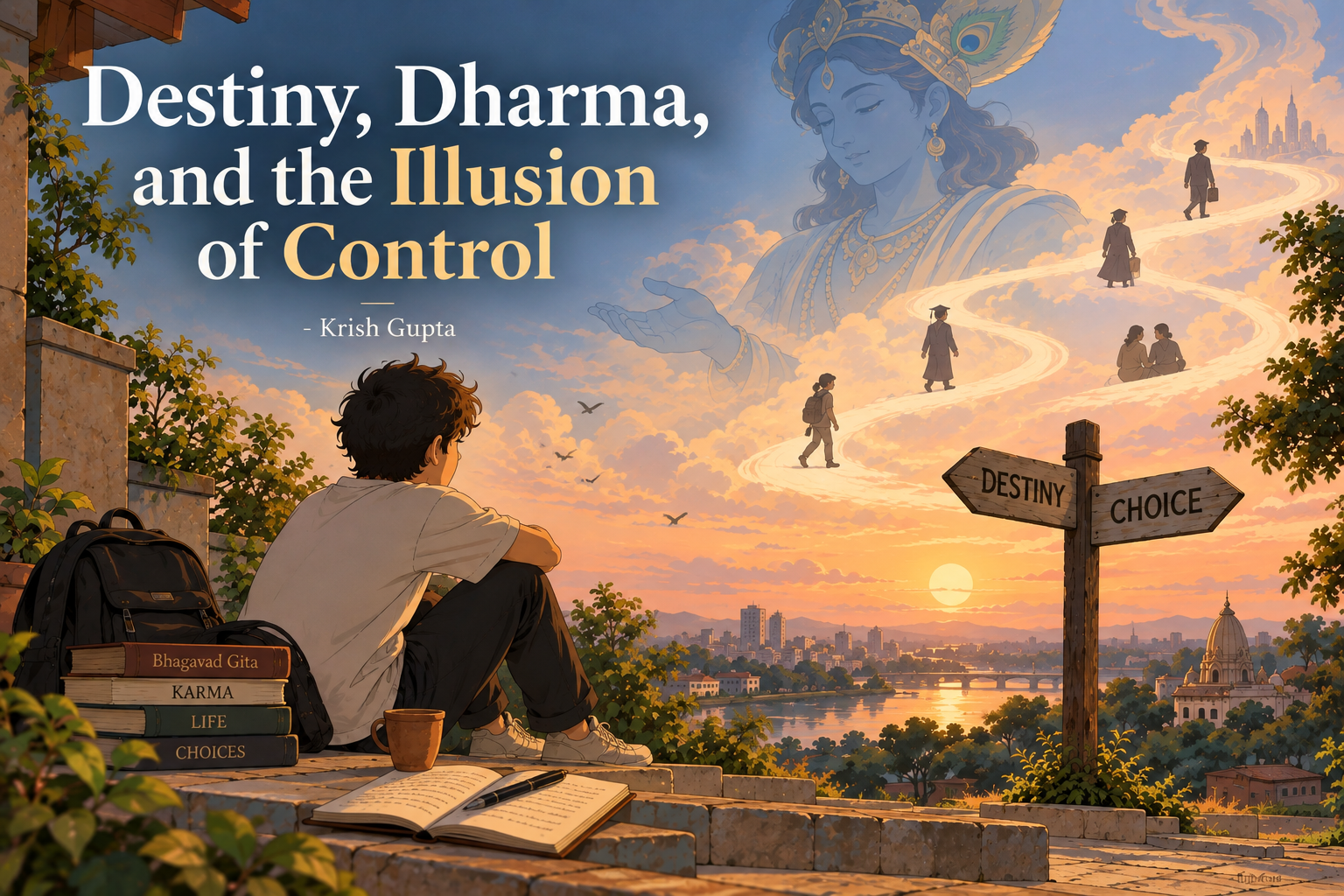
Destiny, Dharma and the Illusion of Control

A question about God’s plan, karma, free will, and the strange business of being alive.
By Krish Gupta (BMS’27)
In India, there are sentences we hear almost every time life refuses to go our way: “Sab Bhagwan ki marzi hai”, “Kismat mei jo hai, wahi hoga!” (It is all God’s will). We hear it when someone fails an exam despite studying for months, when a person loses someone they love, when an opportunity slips away, or when life takes an unexpected turn. Sometimes, the sentence brings peace. It reminds us that we are not in control of everything, and perhaps we do not need to be.
But every time I hear it, another question comes to mind. What if everything really is God’s plan? What if every success, every failure, every person we meet, and every decision we make is part of a story whose ending has been decided? If that is true, why are we trying so hard to shape our future? Why study, work, fall in love, or fight for something we believe in? And most importantly, if God already knows how our lives will unfold, why did He give us life in the first place?
It sounds like a simple question until you start thinking about it. Then it becomes difficult to leave alone.
Consider a student preparing for a competitive examination. He spends months studying, sacrifices his free time, misses family occasions, and imagines the life he might build if he succeeds. Yet, on the day the results arrive, his name is nowhere on the list. Someone tells him, “Jo hota hai, acche keliye hota hai!”. And there is nothing wrong with finding comfort in faith. But it does not completely answer the question. Was his failure already decided? Was he meant to learn something from it? Or was it simply one of life’s unpredictable outcomes?
And if he had succeeded, would we have called that God’s plan too? When both success and failure can be explained by the same sentence, I begin to wonder whether we are understanding the plan or simply giving a name to things we cannot explain.
The Bhagavad Gita makes this question even more interesting. One of its most famous verses is quoted across households, classrooms, speeches, and conversations about failure:
Bhagavad Gita Chapter 2 Verse 47:
कर्मण्येवाधिकारस्ते मा फलेषु कदाचन।
(You have a right to action alone, never to its fruits.)
The verse continues by telling us not to make the fruits of our actions our sole motivation and not to become attached to inaction. In simple terms, Krishn asks Arjun to focus on his duty and actions instead of becoming consumed by the result.
I find this advice both beautiful and confusing. If I am supposed to focus on my actions and not their fruits, what exactly does it mean when people say that the fruits are in God’s hands? Does it mean that I should work hard but accept that the outcome may be beyond my control? Or does it mean that the outcome was already decided, regardless of what I did?
There is a difference between these two ideas. I can prepare thoroughly for an examination, but I cannot control the questions that appear. I can care deeply about another person, but I cannot determine how that person will feel. Our actions influence life, but they do not give us complete control over it.
Perhaps this is what the verse asks us to understand. Krishn does not tell Arjun to abandon action because the result is uncertain. In fact, he warns against becoming attached to inaction. The teaching is not that effort is pointless, but that we should not let the uncertainty of the outcome stop us from doing what we believe is right.
Yet, another question remains. If the future is shaped by forces beyond our control, where does our freedom begin?
This is where Indian philosophy becomes fascinating. It has not offered just one understanding of the relationship between God, the individual, and the world. Different traditions have approached the question in different ways, and their differences matter.
Advaita Vedanta: Are we more than what we think we are?
Advaita Vedanta, explained by Adi Shankaracharya, teaches that Brahman is the ultimate reality & that our deepest self is not separate from it. In simple words, we often think we are nothing more than our achievements, jobs, money & relationships. A student fails an examination and starts thinking that he is a failure. Someone loses their job & feels that their life has lost value. But are these things really everything we are, or are they just experiences?
Advaita asks us to look beyond ego and understand who we really are. But this also makes me wonder: if everything is ultimately connected to one reality, then what does it mean when I say that, I have made a choice? Does this mean our decisions are meaningless? Not exactly. In our lives, our actions still have consequences, and we remain responsible for how we behave. Advaita offers a different way of understanding ourselves and the world, but it still leaves us with questions about how our choices fit into the picture.
Vishishtadvaita: Do our choices matter, when we’re dependent on God?
Vishishtadvaita, the philosophy of Ramanujacharya, offers a different way to look at this question. It teaches that we are individuals who are deeply connected to and dependent on God, but we are not exactly the same as God. Think of someone who believes that God is guiding their life but still works hard to achieve the aim. They pray for success, prepare for exams, learn from mistakes, and try again when they fail. Their faith in God does not stop them from taking action themselves.
I find this idea interesting because it suggests that we do not have to control everything for our choices to matter. We may depend on God, but that does not mean we should stop taking responsibility for our lives. Perchance we do not have to choose between trusting God and making our own efforts. The two may exist together.
The Bhagavad Gita itself gives us another reason to take our choices seriously. After teaching Arjun about duty, action, and devotion, Krishn says in Chapter 18, Verse 63:
विमृश्यैतदशेषेण यथेच्छसि तथा कुरु॥
(Reflect on this fully, and then act as you wish.)
Think about the situation. Arjun is confused, Krishn guides him through a difficult conversation, and then asks him to reflect & decide. The verse does not settle every debate about whether our lives are predetermined, but it does place importance on understanding, reflection, and action.
This makes me question whether we sometimes interpret God’s plan too narrowly. Mayhap believing in God does not require us to assume that every decision is meaningless because the ending is already known. Conceivably there is room to believe in reality greater than ourselves while still accepting responsibility for the choices made.
Then comes the idea of karma, which makes the entire question more complicated. In many Sanatana traditions, karma extends beyond one lifetime. Our present circumstances may be influenced by actions from previous lives, while the actions we take today may have consequences that extend beyond our current existence.
But what does this mean for the freedom we have today? Imagine two students preparing for the same examination. One grows up in a family that can afford good schools, private tuition, a peaceful home, and financial support. The other has to balance studies with responsibilities, financial uncertainty, & limited access to opportunities. Both are told to work hard and focus on their karma, but they don’t have the same starting point.
If their circumstances are influenced by past karma, does that mean the second student deserves a more difficult life? I find that conclusion difficult to accept. We cannot see another person’s past lives or know the complete chain of causes behind suffering. To declare that someone is suffering because they deserve it is to claim knowledge we simply do not possess.
Whatever one’s understanding of karma, it should not become an excuse to blame people for ignoring injustice in the present. We may not know why every person experiences what they do, but we can choose whether to respond to a person’s difficulties with compassion or indifference. Belief in karma need not remove our responsibility towards each other.
Feasibly the most uncomfortable part of discussion is the phrase “God’s plan” itself. It can comfort us when we are struggling, but it can also become a convenient way of ending a difficult conversation. When something good happens, we call it God’s plan. When something terrible happens, we call that God’s plan too. When an honest person struggles and a dishonest person prospers, both outcomes are explained in the same way.
But does naming an event explain it? Why does suffering exist? Why do some people face one difficulty after another while others seem to move through life with relative ease? These are difficult questions, and I do not think repeating “Sab karmo ka hisaab hai” (It is all karma) answers them. Sometimes, the more honest response is that we do not know.
This does not mean that faith has no value. For many people, faith provides courage when circumstances become unbearable and a sense of connection with something greater than themselves. The problem begins when the belief that everything is already decided becomes an excuse for refusing to act.
So, why did God give us life if its outcome is already known to Him? Hindu philosophical traditions offer different ways of approaching the purpose of existence. In many of them, life is not merely about achievements or material success. It can be an opportunity to understand the self, fulfil one’s dharma (the fundamental priorities), overcome ignorance, or develop a deeper relationship with the divine. These ideas differ across traditions, and none allows me to claim with certainty that I know God’s ultimate reason for giving us life.
Many things in life are valuable even when we do not get anything in return. A person plants a tree without knowing whether they will ever sit under its shade. Someone helps a stranger without expecting anything back. A student works hard even when success is not guaranteed. In all situations, the result is uncertain, but the actions still have meaning.
None of these examples proves that God created life for a particular purpose. They do, however, challenge the assumption that uncertainty makes our actions meaningless. We do not need to guarantee a result before we can give our best to something. Peradventure we do not need to understand the entire purpose of existence before we can live responsibly within it.
I still do not know why God gave us life or how God’s plan, karma, and our own choices work together. If God already knows everything, are our decisions really our own? And if the fruits of our actions are in His hands, what responsibility do we have? These are questions I still struggle to answer.
But the Bhagavad Gita leaves me with an idea worth considering: Krishn does not ask Arjun to predict the future before acting. He asks him to understand, reflect, and fulfil his responsibility. The uncertainty of the outcome is not presented as a reason to abandon the action itself.
I presume believing in God’s plan does not mean leaving everything to God. We can have faith and still work hard. Likely we do not need to understand the entire plan of God to live our lives well. We just need to do our part and trust the process, even when we do not know where it will lead.
Maybe God has the script. Conceivably, we have misunderstood what that script means. Possibly the future is not ours to command, but the choices made today still shape the lives of people around us & what we become.
And if the Gita asks us to act rather than retreat into inaction, probably we should be careful before using God’s plan as a reason to stop trying.
After all, the question may not simply be whether the ending has already been written. It may be whether we are using the uncertainty of the ending to escape the responsibility of living through the story.
If everything is already part of God’s plan, are we truly the authors of our lives, making our own choices, or are we simply playing our part in a story God has already written?

Comments